Arpan Parichha
Scientist-C |
Decision Unit 5: Functional Biology
Professor |
Academy of Scientific and Innovative Research
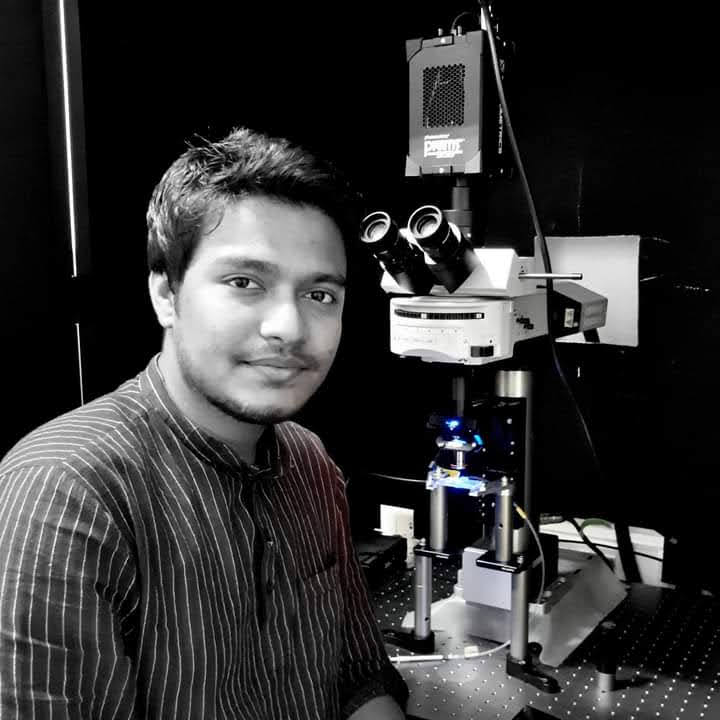
Arpan Parichha studies how environmental and genetic changes during early gestation disrupt brain development, potentially leading to neurodevelopmental disorders. His lab uses mouse models of autism spectrum disorder (ASD) to examine how various cell types shaping the embryonic brain are affected, aiming to uncover ASD-related cellular pathology. Additionally, the lab investigates the impact of environmental factors, such as a maternal high-fat diet, on fetal hippocampal development.
Specific Interests
- Disruption of the choroid plexus-cerebrospinal fluid system in neurodevelopmental disorders
- Effect of a maternal high-fat diet on fetal hippocampal development
- Understanding the role of transient cell types in neurodevelopment and neurodevelopmental disorders
Previous work by Arpan has demonstrated how the spatiotemporal dynamics of Wnt β-catenin signaling developmentally sculpt the choroid plexus, a structure that produces cerebrospinal fluid. Additionally, his research highlights how development of dentate gyrus region of the hippocampus is regulated by β-catenin function in a transient glial cell type called fimbrial glia.
Selected Publications
All Citations →- Constitutive activation of canonical Wnt signaling disrupts choroid plexus epithelial fate. Parichha A, Suresh V, Chatterjee M et al. Nature Communications 13, 633 (2022).
- Dentate gyrus morphogenesis is regulated by β-catenin function in hem-derived fimbrial glia. Parichha A, Datta D, Suresh V, Chatterjee M, Holtzman MJ, Tole S. Development 1 November 2022; 149(21): dev200953.
- BAF (mSWI/SNF) complex regulates mediolateral cortical patterning in the developing forebrain. Nguyen H, Sokpor G, Parichha A, Pham L, Saikhedkar N, Xie Y, Ulmke PA, Rosenbusch J, Pirouz M, Behr R, Stoykova A, Brand-Saberi B, Nguyen HP, Staiger JF, Tole S and Tuoc T (2022). Front. Cell Dev. Biol. 10:1011109.
- Regulation of chromatin accessibility and gene expression in the developing hippocampal primordium by LIM-HD transcription factor LHX2. Suresh V, Muralidharan B, Pradhan SJ, Bose M, D'Souza L, Parichha A, Reddy PC, Galande S, and Tole S (2023). PLOS Genetics 19(8): e1010874.