Kausik Chakraborty
Scientist-G |
Decision Unit 4: Systems Biology
Professor |
Academy of Scientific and Innovative Research
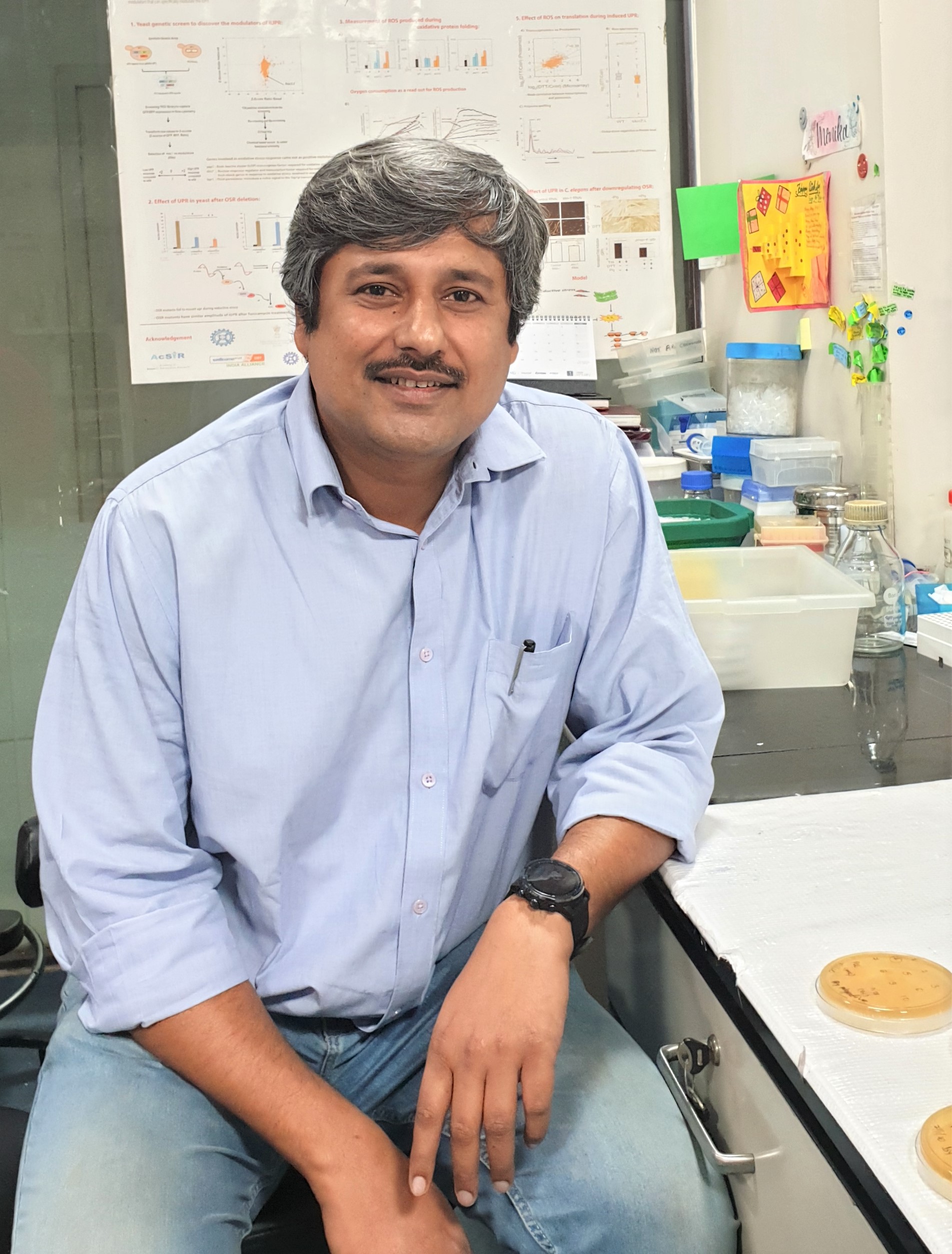
Kausik Chakraborty's lab studies the fundamental mechanism of protein folding homeostasis (proteostasis) and its functional implications in misfolding stress. The lab explores new pathways and signalling mechanisms that contribute to cellular proteostasis, with a focus on how metabolic states influence this buffering mechanism.
Specific Interests
- Metabolic homeostasis and protein folding in vivo
- Pathways regulating proteostasis
- Cellular sensors of protein misfolding
- Designing small molecules for protein folding
Evolution is driven by genetic variation, and organisms often buffer mutations to maintain stable phenotypes. His research shows that metabolism plays a key role in buffering mutational variation through changes in protein folding capacity.
Using E. coli as a model system, the lab studies how metabolic states influence this buffering mechanism, helping to understand adaptation, evolution, and cellular resilience.
Selected Publications
All Citations →- Integrating an ER Stress Reporter for Monitoring Genome-Wide UPR-ER in Budding Yeast. Maity S, Ghosh A, Chakraborty K. Methods Mol Biol. 2022;2378:189–201.
- Distinct metabolic states of a cell guide alternate fates of mutational buffering through altered proteostasis. Verma K, Saxena K, Donaka R, Chaphalkar A, Rai MK, Shukla A, Zaidi Z, Dandage R, Shanmugam D, Chakraborty K. Nat Commun. 2020 Jun 10;11(1):2926.
- Cellular responses to proteostasis perturbations reveal non-optimal feedback in chaperone networks. Ghosh A, Gangadharan A, Verma M, Das S, Matai L, Dash DP, Dash D, Mapa K, Chakraborty K. Cell Mol Life Sci. 2019 Apr;76(8):1605–1621.
- Proteomic profile of 4-PBA treated human neuronal cells during ER stress. Kaur B, Bhat A, Chakraborty R, Adlakha K, Sengupta S, Roy S, Chakraborty K. Mol Omics. 2018 Feb 1;14(1):53–63.
- Oxidative Homeostasis Regulates the Response to Reductive Endoplasmic Reticulum Stress through Translation Control. Maity S, Rajkumar A, Matai L, Bhat A, Ghosh A, Agam G, Kaur S, Bhatt NR, Mukhopadhyay A, Sengupta S, Chakraborty K. Cell Rep. 2016 Jul 19;16(3):851–65.